

Modules
MEPA wideband immittance
Middle-ear power analysis (MEPA)
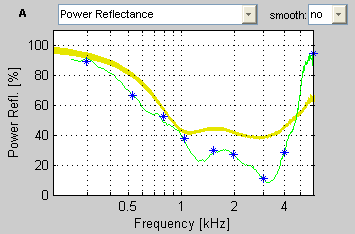
Our clinical wideband acoustic immittance (WAI) systems use middle-ear power analysis (MEPA) to provide a non-invasive method for characterizing middle-ear transduction with acoustic power assessment. Mimosa Acoustics is the first to bring this new technology into the hands of clinicians on our HearID and OtoStat systems.
Within seconds, measurements characterizing the middle ear over a wide frequency range are obtained, without changing the pressure in the ear. Pairing otoacoustic emission measurements with MEPA measurements provides diagnostic information about both the middle and inner ear. OtoStat takes the next step by using MEPA information to more accurately calibrate acoustic stimuli in all the other measurement modules.
For use in all age groups: newborns, infants, children and adults.
Resources
MEPA on OtoStat
To run MEPA on OtoStat, you need a OtoStat software and hardware system and the Mimosa Acoustics calibration cavity set. MEPA underlies all measurements on OtoStat - it is used for accurate in situ calibration, including the option for forward pressure level.
- Measurements include: Power Reflectance, Power Absorbance (Transmittance), Equivalent Volume, Acoustic Impedance, Acoustic Resistance, Acoustic Reactance, Acoustic Admittance, Acoustic Conductance, Acoustic Susceptance; and depending on age demographic, reflectance area index for relevant frequencies, and absorbance level difference.
- Frequency range: 200 to 8000 Hz.
- Intensity: 0 to 85 (default 60) dB SPL.
- Sample Time: approximately 4 seconds in low-noise conditions.
- Stimuli: Chirp & Pure Tone.
- Artifact Rejection.
- Real time display of signal and noise.
- Normative data.
- Customize measurement protocols.
- Factory probe calibrations are provided. Probes should be verified weekly using a quick inbuilt test, but only need recalibrating if verification fails.
MEPA3 on HearID
The original MEPA system. To run MEPA3 on HearID, you need a HearID software and hardware system, with the MEPA3 Measurement Module and the Mimosa Acoustics calibration cavity set.
- Measurements include Power Reflectance, Power Absorption, Power Transmittance, Acoustic Impedance, Acoustic Resistance, Acoustic Reactance, Acoustic Admittance, Acoustic Conductance, Acoustic Susceptance.
- Frequency range: 200 to 6000 Hz.
- Intensity Range: 0 to 80dB SPL.
- Sample Time: 0.1 to 10 seconds per point.
- Stimuli: Chirp & Pure Tone.
- Artifact Rejection.
- Real time display of signal and noise.
- Normative data.
- Customize measurement protocols.
- Customize display parameters.
- MEPA probe calibration: an essential step in making a reflectance measurement. Calibration is quick and easy; typically taking less than one minute. A calibration is made for each eartip type. For best results, calibrate before every patient; however, calibrating daily may be sufficient for many applications.
MEPA and UNHS

Why use MEPA with infant hearing screening?
The goal of any UNHS (Universal Newborn Hearing Screening) program is to correctly identify ears with hearing loss and correctly identify ears with normal hearing. In the newborn population, the incidence of conductive hearing loss is greater than sensorineural hearing loss. Usually, the conductive component is transient. Information on middle ear status improves the ability to correctly predict hearing status.
Tympanometry is not reliable in very young infants. It is possible to obtain abnormal 220 Hz tympanograms in infants less than 4 months when their middle-ear system is normal. Furthermore, normal results are possible in infants below 4 months of age even when middle ear effusion is present. The problem with tympanometry is that static pressurization of the ear canal produces large changes in the ear canal volume due to changes in the ear canal diameter. Until MEPA3, there was not a clinically accepted acoustic test of middle-ear status applicable to the neonatal population.
With our patented calibration techniques, MEPA can measure wideband power reflectance to 6 kHz, without the need for a pressurized ear canal. Power reflectance is a measure of middle-ear inefficiency. It is the ratio or percentage of power reflected from the eardrum to the incident power, as a function of frequency. Acoustic power measurements objectively quantify middle-ear function and malfunction.